Page 60 - Malaysia 2016
P. 60
2016
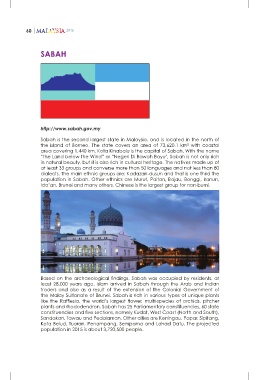
SABAH
http://www.sabah.gov.my
Sabah is the second largest state in Malaysia, and is located in the north of
the island of Borneo. The state covers an area of 73,620.1 km² with coastal
area covering 1,440 km. Kota Kinabalu is the capital of Sabah. With the name
“the Land below the Wind” or “Negeri Di Bawah Bayu’, Sabah is not only rich
in natural beauty, but it is also rich in cultural heritage. The natives made up of
at least 33 groups and converse more than 50 languages and not less than 80
dialects. The main ethnic groups are: Kadazan-dusun and that is one third the
population in Sabah. Other ethnics are Murut, Paitan, Bajau, Bonggi, Iranun,
Ida’an, Brunei and many others. Chinese is the largest group for non-bumi.
Based on the archaeological findings, Sabah was occupied by residents, at
least 28,000 years ago. Islam arrived in Sabah through the Arab and Indian
traders and also as a result of the extension of the Colonial Government of
the Malay Sultanate of Brunei. Sabah is rich in various types of unique plants
like the Rafflesia, the world’s largest flower, multi-species of orchids, pitcher
plants and rhododendron. Sabah has 25 Parliamentary constituencies, 60 state
constituencies and five sections, namely Kudat, West Coast (North and South),
Sandakan, Tawau and Pedalaman. Other cities are Keningau, Papar, Sipitang,
Kota Belud, Tuaran, Penampang, Semporna and Lahad Datu. The projected
population in 2015 is about 3,720,500 people.