




 20-21 / 32

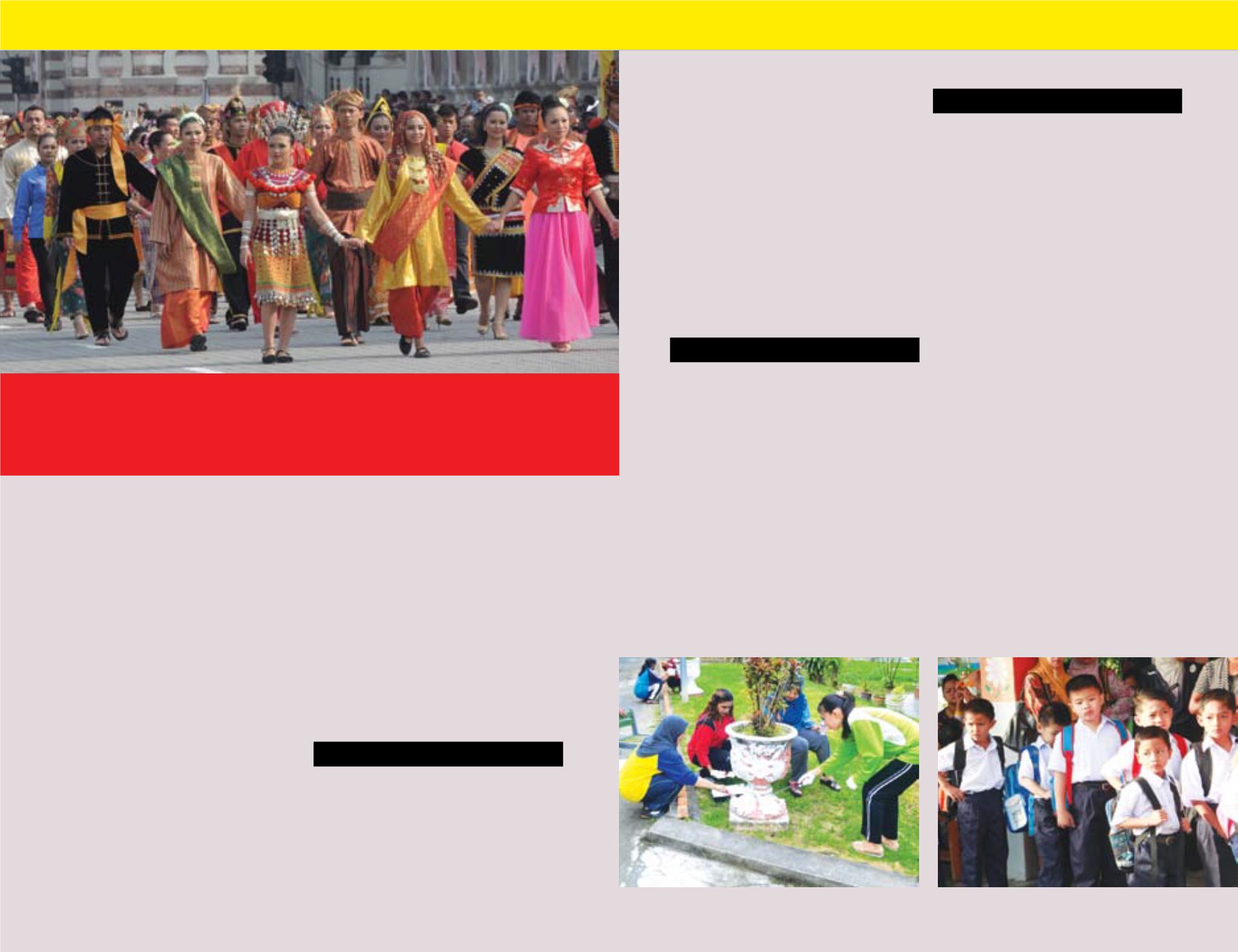
C u lt u r e a s a s e t o f b o n d i n g a n d s o c i a l i n t e g r at i o n
“Values held by members
of the community have
their own source. The
main and most important
source comes from the
family, the parents and
the elders who provide
wisdom to the family.
And through them,
their children receive
normative instructions”
Prime Minister Dato’ Sri Mohd Najib Tun Razak
has reminded the people that the future of the
country depends on the system, values, culture
and attitudes of the society. According to him,
the success of a country is not only subject
solely to the skyscrapers, high technology and
in the increasing per capita but it also depends
on the culture that we have. Basic philosophy
and cultural values of a society are able to
develop a vision, thinking, behavior and actions
as well as to adapt to environmental awareness
and change.
According to Talcott Parsons and Alfred Kroeber
(1958), the culture of a society refers to the
content of the values, ideas and symbolic in that
community. It is a matter of community members
who are sharing the meaning, understanding
and judgement. This means that culture will
create an identity, meaning, purpose and well-
being.
The essence of culture
The basic thing that must be understood is that
‘value’ is an important element of culture. Cultural
values formed is related to the “ought,” “should”
and “must”. This means that the essence of
the culture of what should be supported and
maintained by members of the public and what
should be avoided.
Culture As a Set of Bonding
and Social Integration
The integrated system provides awareness to
the community to act within the framework of
a sense of belonging and togetherness. In this
context, culture is a social sensitivity that can
bind individual relationships with others so that
the community can live, interact and work in
peace and harmony.
Collectivism requires the community members
to make sacrifices in their personal interests
(individualism) in order to achieve common
interests (collective) where any member of the
public considers each member to be in a union
and solid as well as sturdy solidarity. It shows
that culture can act as a set of social integration
that can unite the community.
Family is the main source
Values held by members of the community have
it own sources and the most basic and essential
sources are family, parents and the elders who
are the roots for family wisdom. Through them,
their children receive normative instruction.
Moreover, another important source for value
is the influence from formal education including
school environment. In this context, teachers
and learning systems (including curriculum) will
strengthen the understanding of the values and
practices of community members.
The next source to strengthen our value is
higher education institution, participation in
group or social activities and one’s career. Work
field and the involvement in social groups form
the secondary values which later will integrate
with the core values.
Values should not be static
The values should not be static and it should
be assimilated with the new values coming
from the various forces and external influences.
Modernization and globalization may force us to
accept a new set of values. However, the new
values should not be blindly accepted so that
we will not wipe out our own traditional roots
and finally lose our identity.
As for example, the acceptance of the unlimited
freedom will destroy our society since freedom
can nourish the individualistic attitude and non-
compliance with regulations and laws. Thus, in
our eagerness to accept new values, we must
first preserve and strengthen the roots of the
valuable for maintaining our identity.
Development should not be achieved by ignoring
the honour of our culture. Former Prime Minister,
Tun Dr Mahathir Mohamad once said that in
order to achieve development, people, especially
the youth, must control their desires and adopt
the culture because sometimes freedom will
lead to a weak nation and disgraced. According
to Tun, politeness, customs, disciplines and
perseverance must be maintained. According
to him, the institution of marriage and family are
responsible in providing education manners,
values and respectful morals.
**Author is a Media Analyst at the National Policy
Publications Division, The Department of Information,
Ministry of Communications and Multimedia.
Features
by
Mohd Ayop Abd Razid
M A L AY S I A
F O C U S
• A U G U S T 2 0 1 4
2 1
2 0
M A L AY S I A
F O C U S
• A U G U S T 2 0 1 4