



 10-11 / 32

M A L AY S I A U n d e r S i x N at i o n a l L e a d e r s h i p s
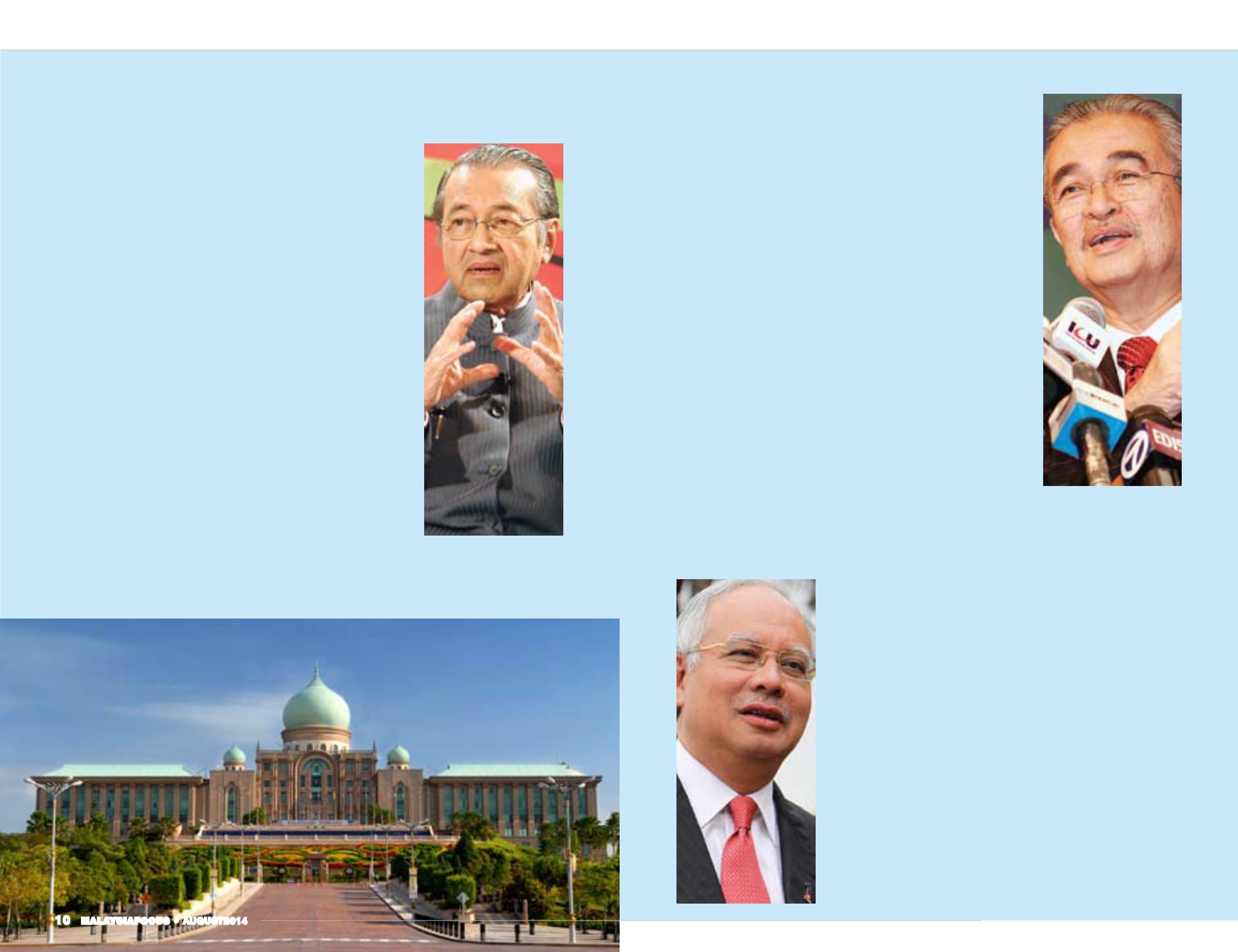
THE ERA OF TUN DR. MAHATHIR
MOHAMAD
(16 JULY 1981 – 31 OCTOBER 2003)
In line with the title of “Father of Modernization”, Tun Dr. Mahathir
successfully turned Malaysia into a modern and competitive nation
with a multitude of high-profile policies and projects which have
become famous throughout the world.
Early in his administration, Tun introduced the “Look East Policy”
and followed it with the “Clean, Efficient and Trustworthy” campaign.
The Proton Saga project to produce the nation’s first car in 1985
propelled Malaysia from an agriculture-based one.
The introduction of “Vision 2020” in 1990 charted Malaysia’s path to
gaining developed-nation status by outlining nine challenges to the
aim and direction of the government and the people. Tun’s success
in overcoming the economic crisis which hit in 1990 also further
elevated Malaysia’s standing in the eyes of the world.
The initiative to drive Malaysia to achieve developed status was
continued with the launching of the Multimedia Super Corridor (MSC)
in 1996, which placed Malaysia on the path toward a knowledge-
based economy through projects such as electronic government,
tele-medicine and others.
Tun Dr. Mahathir also implemented various mega
projects, which also elevated Malaysia’s reputation as
a globally-recognized sovereign nation. They include
the Penang Bridge, Kuala Lumpur International Airport
(KLIA), Petronas Twin Towers, Kuala Lumpur Tower and
the Putrajaya Administration Center. Although these
projects were initially met with numerous criticisms,
they later proved to be major stimulants to national
economic development and a source of envy at the
global level.
THE ERA OF TUN ABDULLAH HAJI
AHMAD BADAWI
(31 OCTOBER 2003 – 2 APRIL 2009)
During his administration, Tun Abdullah bin Haji Ahmad Badawi
continued with efforts to turn Malaysia into a developed nation in
line with Vision 2020, and based on Islam Hadhari principles.
Tun Abdullah also gave special attention
to graft prevention efforts with the setting up
of the Malaysian Anti-Corruption Academy
(MACA) and enhanced the functions of the
Anti-Corruption Agency by turning it into
the Malaysian Anti-Corruption Commission
(MACC).
Tun Abdullah also pushed Malaysia to explore new areas by
formulating various policies such as the National Bio-technology
Policy, National Automotive Policy and the National Biofuel Policy.
The successful construction of Malaysia’s second micro-satellite,
RazakSAT and its rocket launcher Falcon 1 by local companies and
worker proved Malaysia’s abilities in aerospace technology. The
Malaysian Space Center was also set up to manage RazakSAT’s
activities as well as to forge global cooperation in the aerospace
field.
Through the Ninth Malaysia Plan, Tun Abdullah formulated the
National Mission, focusing on adding value to the national economy
by creating activities based on knowledge and employment
opportunities in ICT, biotechnology, nanotechnology and aerospace
service. Tun Abdullah also revolutionized national human capital
development by introducing the National Human Capital Policy.
THE ERA OF Dato’ Sri
Mohd Najib Tun Abdul Razak
(3 APRIL 2009 – PRESENT)
Dato’ Sri Mohd Najib Tun Abdul Razak’s leadership is prominently
highlighted through the various transformation programs
implemented since he ascended the government top seat.
Realizing that the country economy is on the crossroad, actions
plans which involve all aspects of the economy were swing into
action with the objective to uplift the economy from a middle-income
to a high-income earners of a developed nation in line with the 2020
vision.
The slogan ‘People First, Performance Now’,
envisaged by Najib became the core principle
of the 1Malaysia transformation programs that
is currently being implemented.
The programs covers a wide scope from the socio-political sector,
economic, education and socio-cultural which also include the
upgrading of laws and regulations.
M A L AY S I A
F O C U S
• A U G U S T 2 0 1 4
1 1
1 0
M A L AY S I A
F O C U S
•
A U G U S T
2 0 1 4