



 8-9 / 32

SPECIAL ISSUE
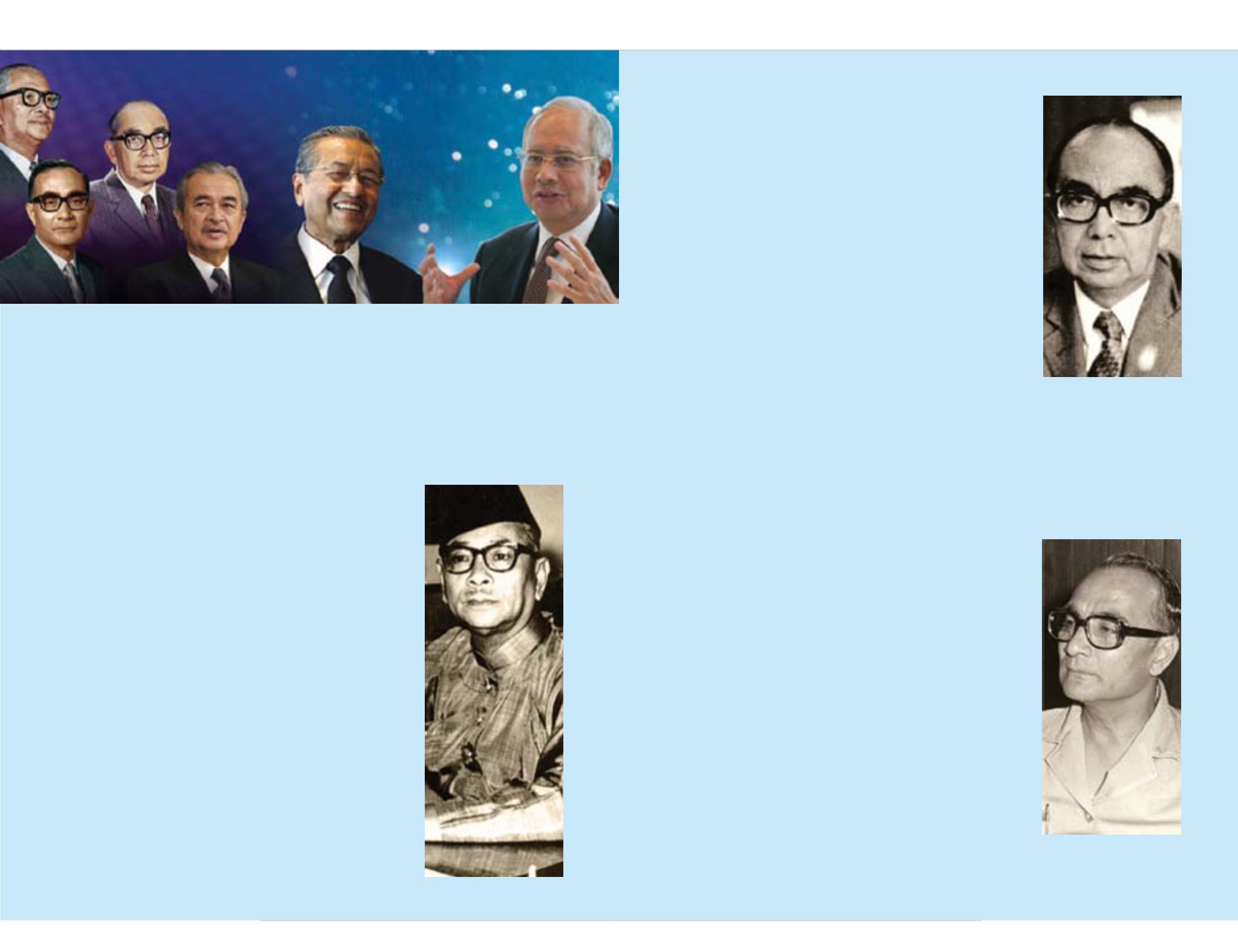
M A L AY S I A U n d e r S i x N at i o n a l L e a d e r s h i p s
THE ERA OF TUNKU ABDUL
RAHMAN PUTRA AL-HAJ
(31 AUGUST 1957 – 21 SEPTEMBER 1970)
As a pioneer of the era of independence, Tunku Abdul Rahman
Putra Al-Haj played a major role in efforts to secure the nation’s
independence from the yoke of colonialism without spilling blood in
1957 and the formation of Malaysia in 1963.
Tunku’s huge contribution in achieving independence and
uniting the various races in peninsular, Sabah, Sarawak and
Singapore who practice different religions, cultures and
languages under the banner of Malaysian Federation, has
earned Tunku the title of “Father of Independence”.
Throughout his administration, Tunku brought a multitude of
changes to Malaysia by implementing the five-year development
strategy beginning with the First Malaya Plan for the 1956 - 1960
and the Second Malaya Plan for the 1961 - 1965. Through these
five-year plans, various economic rehabilitation and generation
programmes were implemented such as the Malaysian Industrial
Development Authority (MIDA), the People’s Trust Council (MARA),
Bank Bumiputera and the National Corporation Berhad (PERNAS).
Apart from that, various policies which serve as administrative
guidelines were also introduced. They include the National
Education Policy (1956), Culture Policy and the National Language
Act (1963/67). Tunku Abdul Rahman also propelled Malaysia into
the international arena by forming the Association of Southeast
Asia (ASA) in 1961. ASA has developed into ASEAN, which now
comprises ten Southeast Asian nation.
Tunku also created history by uniting UMNO, MCA and MIC under
the Alliance banner. The coalition later became known as Barisan
Nasional (BN) and has ruled Malaysia to the present time.
THE ERA OF TUN ABDUL RAZAK
HUSSEIN
(22 SEPTEMBER 1970 – 14 JANUARY 1976)
In his administration, Tun Razak focused on four areas-reducing
the poverty rate, developing the nation and people and ensuring
social justice among the people. Tun Razak spurred Malaysia’s
development through the Rural Development Plan (Buku Merah) and
implemented economic development through the New Economic
Policy (NEP). The success of his national development programme
earned Tun Razak the tittle “Father of Malaysian Development”.
Tun Razak also succeeded in strengthening Malaysia’s relations with
other countries. His diplomatic practices successfully ended the
Malaysian-Indonesian Confrontation and cemented close tie with
China. These strategies enhanced Malaysia’s status as a sovereign
nation in the eye of the world.
8
M A L AY S I A
F O C U S
• A U G U S T 2 0 1 4
M A L AY S I A
F O C U S
• A U G U S T 2 0 1 4
9
Malaysia
Under Six National Leaderships
THE ERA OF TUN HUSSEIN DATUK
ONN
(15 JANUARY 1976 – 16 JULY 1981)
National unity figured prominently in every policy
development plans formulated during the era of Tun
Hussein Onn. For that, he was bestowed the title
of “Father of Unity”. Racial issues which had been
threatening previously were successfully eliminated and
racial unity among the people was achieved.
Tun Hussein also worked to sustain the economic development
momentum by breathing new life into the NEP, especially by
introducing the Amanah Saham Nasional specifically to enhance
the living standards of the Bumiputeras, which was quite low at
that time.
Tun Razak spurred Malaysia’s development through the Rural
Development Plan (Buku Merah) and implemented economic
development through the New Economic Policy (NEP). The success
of his national development programme earned Tun Razak the tittle
“Father of Malaysian Development”.